Work gives most of us a ready-made sense of purpose. So once you’re no longer working — with the time, at last, to do whatever you choose — how will you fill your days in a way that truly means something to you? The Japanese even have a word for it: ikigai.
A few months into retirement — once the to-do list is finally done and the first trips are behind you — a quiet question tends to surface: what now? After a working life spent being needed, by a boss, a team or a business, the sudden absence of all that can feel less like freedom and more like an empty room.
That feeling is worth taking seriously, and it deserves a better answer than “take up golf”. Helpfully, other people have thought hard about exactly this. In Japan, the idea is captured in a single word: ikigai (say “ee-key-guy”), which translates roughly as “a reason to get up in the morning”.
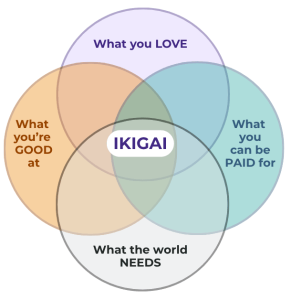
Ikigai isn’t one grand calling that arrives in a flash of lightning. In Japan — and especially on Okinawa, an island famous for its unusually long and contented lives — it’s something quieter: a steady, daily sense that your life has a point. You’ll see it drawn all over the internet as four overlapping circles. The original idea is gentler than that tidy diagram makes out — your ikigai needn’t earn a single dollar, and it needn’t be grand — but the four questions are a genuinely useful place to begin.
Your ikigai sits where the circles overlap — though in truth, the “paid for” one is entirely optional.
Take each circle in turn, and be generous with your answers.
What do you love? The things you’d happily do for their own sake — the garden, the grandkids, the long table of old friends, the novel you keep meaning to write. Notice whatever makes you lose track of an afternoon. For a lot of us, this is the circle we’ve ignored the longest.
What are you quietly good at? Forty years of work left you skilled at things you’ve stopped even noticing: an eye for detail, a way with anxious people, a knack for fixing what others give up on. Those abilities don’t clock off the day you do.
What does the world around you need? Look close to home before you look far afield — a grandchild who needs minding, a neighbour who can no longer drive, a local club crying out for someone reliable. Being needed turns out to be one of the great tonics of later life.
What could you be paid for? This is the circle the Western diagram insists on, and the one to hold most loosely. A purpose that never earns a cent is still a purpose. But if a small income happens to make the thing easier to keep doing, there’s no shame in that either.
Your ikigai lives somewhere in the middle, where those circles overlap. It might be coaching the juniors at the local club, mentoring someone half your age, restoring old furniture, or running the community garden. You’ll know it when you land on it: it’s the thing you’d happily set an alarm for, on a day when you didn’t have to.
Don’t expect to find it by sitting and thinking. Purpose is discovered by doing, not by overthinking it, so start absurdly small — one new thing, one morning a week, for a month. A little momentum will show you more than an afternoon of staring out the window ever could, and it’s far easier to adjust something you’ve actually begun than something that only exists in your head.
Then give it a shape and a time. A vague “I really should volunteer” almost never happens; “Tuesday mornings at the men’s shed” does. Purpose loves a standing appointment — pin it to the calendar, let the habit take hold, and the meaning tends to follow the routine rather than the other way around.
And don’t feel you must land on a single answer. Plenty of people find their purpose is really several smaller things stitched together — a bit of minding the grandchildren, a morning at the op-shop, a vegetable patch that feeds half the street. A handful of small purposes is every bit as good as one grand one, and a good deal more resilient when life shifts, as it always eventually does.
Here’s the quiet truth the ikigai idea gets right: a long retirement is a wonderful gift, but only if you have a reason to get up and meet it. You spent decades being useful to an employer who set your priorities for you. These years are your chance to be useful to the things you choose — and, for once, to yourself. So take a clean sheet of paper, draw those four circles, and start filling them in. No answer is too small. Somewhere in the middle of them is the shape of the rest of your life.
FCA (ICAEW) at Plan4wealth | Mary Benton is a seasoned retirement advisor with a wealth of experience and qualifications to guide you towards financial security and peace of mind.
Mary Benton brings decades of experience in retirement planning and financial management to the table. As a qualified financial planner and retirement specialist, Mary has helped countless individuals and couples navigate the complexities of retirement planning with confidence and clarity.